English
 français
 Deutsch
 Español
 русский

In modern communication, navigation, and test systems, timing precision defines performance. As technology advances, engineers are increasingly focused on minimizing phase noise, a critical parameter that affects signal integrity, jitter, and frequency stability. Among crystal oscillator technologies, the ultra low phase noise TCXO (Temperature Compensated Crystal Oscillator) has emerged as a superior solution for high-performance applications. But how exactly does it differ from a standard TCXO, and when should you choose one over the other?
A TCXO (Temperature Compensated Crystal Oscillator) is a frequency control device that adjusts its output frequency in response to temperature changes. By compensating for thermal drift, TCXOs provide a more stable and reliable frequency than ordinary crystal oscillators.
Typical frequency range: 1 MHz – 100 MHz
Temperature range: -40°C to +85°C (depending on design)
Typical stability: ±0.5 ppm to ±2.5 ppm
These characteristics make TCXOs essential in wireless communications, GPS receivers, and precision instrumentation where temperature fluctuations can impact signal accuracy.
An ultra low phase noise TCXO takes the standard design a step further. It uses a specially engineered crystal blank, optimized circuit topology, and advanced temperature compensation algorithms to reduce phase noise—the small, rapid fluctuations in frequency that appear as noise on the signal.
In essence, an ultra low phase noise TCXO provides exceptional signal purity and spectral stability, making it ideal for applications that require ultra-clean reference signals such as radar, satellite communication, and RF testing.
| Parameter | Standard TCXO | Ultra Low Phase Noise TCXO |
|---|---|---|
| Frequency Stability | ±0.5 to ±2.5 ppm | ±0.1 to ±0.5 ppm |
| Phase Noise (10 Hz offset) | -100 dBc/Hz (typ.) | -130 dBc/Hz or better |
| Output Jitter | ~500 fs | <100 fs |
| Typical Applications | GPS, IoT modules, consumer electronics | Radar, 5G, test instruments, satellite systems |
Phase noise directly affects signal quality and performance. In communication systems, higher phase noise can increase bit error rates and degrade overall data integrity. In measurement systems, it can distort readings and reduce accuracy.
For example:
In radar systems, phase noise determines the ability to detect small or distant targets.
In 5G base stations, it affects synchronization and data throughput.
In GNSS modules, it influences positioning precision.
An ultra low phase noise TCXO helps mitigate these problems by ensuring that the signal’s phase remains stable, clean, and predictable—even under changing temperatures or mechanical vibration.
Crystal Selection and Processing
Ultra low phase noise TCXOs use high-Q (quality factor) crystals that exhibit minimal mechanical and thermal noise. The cutting angle and crystal aging control are optimized to reduce flicker noise.
Circuit Design
Special low-noise amplifiers and compensation networks are integrated to suppress both electrical and thermal disturbances.
Temperature Compensation Algorithm
While both types employ compensation curves, ultra low phase noise TCXOs use finer calibration steps and digital compensation to maintain ultra-stable frequency over wide temperature ranges.
Output Purity
The result is a cleaner spectral output, allowing systems to achieve lower jitter and higher accuracy.
Selecting between a standard TCXO and an ultra low phase noise TCXO depends on your system’s requirements.
| Application Type | Recommended TCXO Type | Reason |
|---|---|---|
| Consumer electronics, IoT, handheld devices | Standard TCXO | Balance of cost and performance |
| Base stations, timing references, radar, test equipment | Ultra Low Phase Noise TCXO | Highest frequency purity and phase stability |
| Satellite communication, aerospace systems | Ultra Low Phase Noise TCXO | Required for precision synchronization and low jitter |
If your project demands extremely clean reference signals or must meet tight phase noise specifications, investing in an ultra low phase noise TCXO is essential for long-term reliability and performance.
At XtalTQ, we specialize in designing and manufacturing high-performance crystal oscillators for demanding applications. Our ultra low phase noise TCXO series delivers:
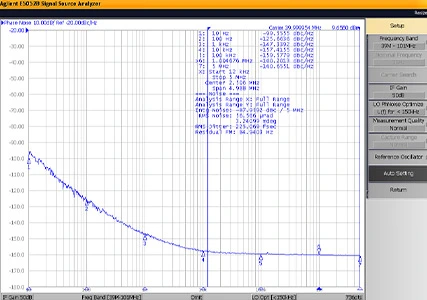
Phase noise as low as -150 dBc/Hz at 10 kHz offset
Exceptional temperature stability up to ±0.1 ppm
Compact SMD packages suitable for space-constrained designs
Custom frequency options tailored to your system requirements
Each product undergoes strict testing for vibration sensitivity, frequency aging, and long-term reliability, ensuring outstanding performance in mission-critical systems.
For example, our XTQ-ULN-TCXO Series is widely used in:
Satellite ground stations
RF measurement instruments
5G small cells and network synchronization systems
By leveraging decades of oscillator expertise, XtalTQ provides precise, consistent, and ultra-stable timing components that help engineers push system performance to new levels.
In summary, the difference between a standard TCXO and an ultra low phase noise TCXO lies in signal purity, phase noise performance, and stability. While standard TCXOs are suitable for cost-sensitive and general applications, ultra low phase noise TCXOs are indispensable for high-end systems where every dB of noise matters.
If your design demands exceptional frequency accuracy and minimal phase noise, explore XtalTQ’s ultra low phase noise TCXO solutions — engineered to power the next generation of precision communication and measurement technologies.