English
 français
 Deutsch
 Español
 русский

Phase noise is not merely an oscillator specification buried in a datasheet—it directly influences the real-world performance of communication systems, radar platforms, test equipment, and high-speed digital networks. Excessive phase noise can increase Bit Error Rate (BER), degrade Error Vector Magnitude (EVM), reduce receiver sensitivity, and ultimately limit the performance of an entire system regardless of how advanced other components may be.
For engineers designing RF, wireless, aerospace, satellite, or precision timing systems, understanding the relationship between oscillator phase noise and system-level performance is essential when selecting a low phase noise oscillator or an ultra low phase noise oscillator.
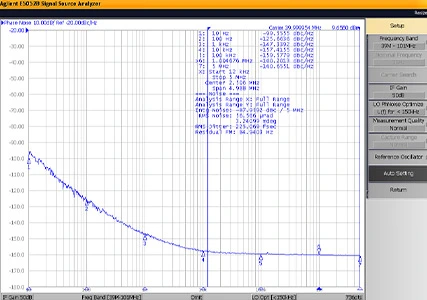
Phase noise refers to the short-term random fluctuations in the phase of an oscillator signal. In the frequency domain, it appears as unwanted noise sidebands around the carrier frequency.
Rather than producing a perfectly clean signal, every oscillator generates some amount of phase noise due to thermal noise, flicker noise, resonator limitations, and active circuit imperfections.
Phase noise is typically expressed in dBc/Hz at specific frequency offsets from the carrier, such as:
10 Hz
100 Hz
1 kHz
10 kHz
100 kHz
1 MHz
The lower the phase noise value, the cleaner the signal.
Many engineers focus primarily on frequency accuracy and stability when selecting oscillators. However, phase noise often becomes the hidden performance bottleneck in modern communication systems.
High phase noise can lead to:
Increased BER
Poor EVM performance
Reduced receiver sensitivity
Lower spectral efficiency
Reduced modulation accuracy
ADC and DAC performance degradation
Radar resolution loss
Reduced communication range
As wireless systems move toward higher frequencies and more complex modulation schemes, oscillator phase noise becomes increasingly critical.
Although these metrics are often evaluated separately, they are closely interconnected.
| Performance Metric | Impact of High Phase Noise |
BER | Increases bit errors |
EVM | Increases constellation distortion |
Receiver Sensitivity | Reduces ability to detect weak signals |
Spectral Efficiency | Limits high-order modulation |
Signal-to-Noise Ratio (SNR) | Degrades effective SNR |
Communication Range | May decrease coverage distance |
Understanding these relationships helps engineers make better timing component selections early in the design process.
Bit Error Rate measures how frequently transmitted bits are received incorrectly.
Phase noise introduces random phase fluctuations into the carrier signal.
These fluctuations create uncertainty during:
Carrier recovery
Symbol synchronization
Clock recovery
Demodulation
As phase noise increases, the receiver becomes less capable of accurately distinguishing symbol states.
The effect becomes particularly severe with advanced modulation formats:
| Modulation Type | Sensitivity to Phase Noise |
BPSK | Low |
QPSK | Moderate |
16-QAM | High |
64-QAM | Very High |
256-QAM | Extremely High |
1024-QAM | Critical |
For example, a system using 256-QAM may experience significant BER degradation even when signal power remains strong if oscillator phase noise is excessive.
This is one reason why 5G infrastructure and microwave backhaul equipment often rely on an ultra low phase noise oscillator.
EVM has become one of the most important measurements in modern wireless communications.
EVM measures how far received symbols deviate from their ideal constellation positions.
Lower EVM values indicate better signal quality.
When phase noise is present:
Constellation points rotate randomly
Symbol positions become dispersed
Carrier recovery becomes less accurate
Demodulation quality decreases
The result is a higher EVM percentage.
Consider a 5G NR transmitter using 256-QAM.
Even if:
Power amplifier linearity is excellent
Filtering is optimized
Signal strength is high
Poor oscillator phase noise can still prevent the system from meeting EVM requirements mandated by industry standards.
In many cases, upgrading to a higher-performance low phase noise oscillator can significantly improve EVM margins.
Receiver sensitivity determines the weakest signal level that can still be reliably detected.
Phase noise directly impacts this capability.
One of the most important mechanisms is reciprocal mixing.
A receiver's local oscillator phase noise interacts with nearby strong interfering signals.
This process effectively converts oscillator phase noise into additional noise inside the receiver bandwidth.
The result:
Increased noise floor
Lower dynamic range
Reduced sensitivity
Imagine a cellular base station receiving a weak user signal while a strong neighboring carrier exists nearby.
If the local oscillator exhibits poor phase noise:
Interference energy spreads into the desired channel
Signal detection becomes more difficult
Coverage performance decreases
This is why receiver manufacturers frequently prioritize oscillator phase noise over many other timing specifications.
Modern wireless networks rely heavily on:
Massive MIMO
Carrier aggregation
High-order QAM
Dense spectrum utilization
These technologies demand excellent oscillator performance.
Phase noise affects:
Range resolution
Velocity measurement
Target detection
Clutter suppression
Military and aerospace radar platforms typically specify extremely low phase noise requirements.
Satellite links often operate with:
Weak received signals
Narrow bandwidth allocations
High spectral efficiency requirements
Poor phase noise directly reduces link performance.
Equipment such as:
Signal generators
Spectrum analyzers
Vector network analyzers
must maintain exceptional signal purity.
Their performance often depends on an ultra low phase noise oscillator.
Modern ADCs and DACs are increasingly limited by clock phase noise.
As converter resolution and sampling frequencies increase, timing jitter becomes a major system constraint.
These terms are often used interchangeably but represent different views of the same phenomenon.
| Parameter | Domain |
Phase Noise | Frequency Domain |
Jitter | Time Domain |
Phase noise measurements describe spectral purity, while jitter quantifies timing uncertainty.
For high-speed digital systems:
Lower phase noise generally means lower jitter.
Lower jitter often leads to better converter performance.
Both specifications should be evaluated together during oscillator selection.
Not necessarily.
The optimal solution depends on system requirements.
Radar systems
Satellite communications
RF test equipment
5G infrastructure
Microwave radios
Aerospace electronics
Precision instrumentation
Consumer electronics
Basic industrial controls
IoT sensors
General-purpose microcontrollers
In these cases, a standard oscillator may provide sufficient performance at lower cost.
When evaluating oscillator options, engineers should look beyond frequency stability alone.
Important considerations include:
Evaluate phase noise at multiple offsets:
10 Hz
100 Hz
1 kHz
10 kHz
100 kHz
Different applications may prioritize different offset regions.
Review:
RMS jitter
Integrated phase jitter
Application-specific jitter metrics
Consider:
Temperature range
Vibration exposure
Shock resistance
Aging requirements
A lower-cost oscillator may increase:
Design complexity
System calibration needs
Performance limitations
In many professional RF systems, investing in a premium low phase noise oscillator delivers greater long-term value than minimizing initial component costs.
Several crystal-based technologies are commonly used.
| Technology | Phase Noise Performance | Typical Applications |
XO | Good | General timing |
TCXO | Very Good | Wireless communications |
VCXO | Very Good | Clock synchronization |
OCXO | Excellent | Radar, aerospace, instrumentation |
For the most demanding systems, OCXO solutions continue to provide industry-leading phase noise performance.
Before selecting a supplier, engineers should request:
Detailed phase noise plots
Integrated jitter data
Aging specifications
Temperature stability curves
Vibration sensitivity information
Reliability data
Qualification standards
These details often reveal performance differences that are not obvious from headline specifications alone.
Phase noise directly impacts some of the most important performance metrics in modern electronic systems, including BER, EVM, and receiver sensitivity. As communication systems become more complex and spectrum efficiency requirements continue to increase, oscillator quality plays an increasingly significant role in overall system success.
For applications involving wireless infrastructure, radar, satellite communications, precision instrumentation, or high-speed data conversion, selecting a high-performance low phase noise oscillator can substantially improve signal quality and system reliability. In the most demanding environments, an ultra low phase noise oscillator often becomes a critical enabling component rather than simply another timing device.
What is the relationship between phase noise and BER?
Higher phase noise introduces phase errors during signal demodulation, which can increase bit error rates, particularly in systems using high-order modulation schemes.
Why does phase noise affect EVM?
Phase noise causes constellation points to deviate from their ideal positions, increasing modulation errors and worsening EVM performance.
How does phase noise impact receiver sensitivity?
Phase noise can raise the receiver noise floor through reciprocal mixing effects, making weak signals more difficult to detect.
Is phase noise more important than frequency stability?
For many RF and communication systems, phase noise has a greater impact on real-world performance than absolute frequency accuracy.
Which oscillator technology offers the lowest phase noise?
Among commercially available timing technologies, OCXO-based crystal oscillators generally provide the lowest phase noise and highest spectral purity.