English
 français
 Deutsch
 Español
 русский

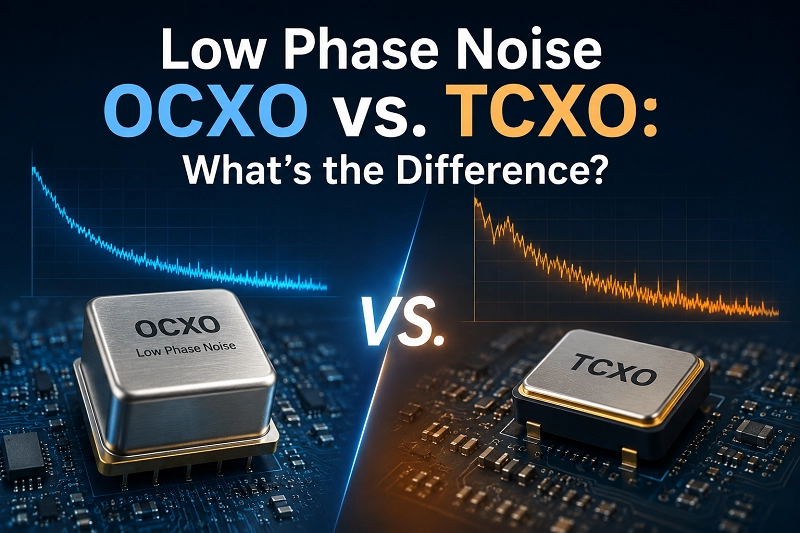
A low phase noise OCXO delivers superior frequency stability and ultra-low phase noise by maintaining a constant internal temperature, making it the preferred choice for high-precision timing systems such as telecom infrastructure, radar, and test equipment. In contrast, a TCXO offers lower cost, smaller size, and reduced power consumption, but with higher phase noise and lower stability. The right choice depends on how critical timing accuracy, noise performance, and environmental stability are in your application.
The distinction between low phase noise OCXO and TCXO is fundamentally about temperature control and performance trade-offs.
OCXO (Oven-Controlled Crystal Oscillator)
Uses a temperature-controlled oven to keep the crystal at a constant temperature, eliminating environmental variations.
TCXO (Temperature-Compensated Crystal Oscillator)
Compensates for temperature drift electronically using correction circuits, without active heating.
From an engineering standpoint, this results in:
| Parameter | Low Phase Noise OCXO | TCXO |
Phase Noise | Extremely low | Moderate |
Frequency Stability | Very high | Moderate |
Warm-up Time | Required | Minimal |
Power Consumption | High | Low |
Size | Larger | Compact |
Cost | Higher | Lower |
Phase noise refers to short-term frequency fluctuations in the oscillator output signal. In RF and timing systems, excessive phase noise can:
Degrade signal integrity
Increase bit error rates in communication systems
Reduce radar resolution
Affect synchronization accuracy
A low phase noise OCXO minimizes these fluctuations, providing a cleaner spectral output—critical in applications where precision timing and signal purity are non-negotiable.
The performance advantage of OCXO comes from thermal isolation and control.
Oven stabilization: Maintains crystal temperature at its optimal point
Reduced frequency drift: Eliminates ambient temperature influence
Improved Q-factor stability: Enhances spectral purity
This is why low phase noise OCXO devices are widely used in:
5G base stations
GPS/GNSS timing modules
Frequency synthesizers
Precision instrumentation
TCXO relies on temperature compensation algorithms rather than physical stabilization.
Uses temperature sensors and correction circuits
Adjusts frequency in real time
No heating element required
This makes TCXO ideal for:
Portable electronics
IoT devices
Consumer GPS modules
Battery-powered systems
However, compensation cannot fully eliminate temperature-induced variations, which limits its performance compared to OCXO.
A low phase noise OCXO is the right choice when:
Phase noise directly impacts system performance
Long-term frequency stability is critical
The system operates in fluctuating temperature environments
High-end synchronization is required
Telecom timing (e.g., base stations, synchronization units)
Aerospace and defense systems
High-frequency trading infrastructure
Test and measurement equipment
TCXO is more suitable when:
Power consumption must be minimized
Space is limited
Cost constraints are significant
Ultra-high precision is not required
Wearable devices
Mobile communication modules
Automotive electronics
Standard GPS receivers
In most high-precision systems, TCXO cannot fully replace an OCXO.
While TCXO provides acceptable stability for general applications, it lacks:
Ultra-low phase noise
Long-term aging stability
High holdover performance
In telecom synchronization, for example, TCXO may serve as a backup or entry-level solution, but OCXO remains the standard for critical timing layers.
Low phase noise directly influences signal clarity and system reliability.
Improved modulation accuracy in communication systems
Better adjacent channel performance
Enhanced radar detection resolution
Reduced jitter in clock distribution networks
For engineers designing RF systems, selecting a low phase noise OCXO is often a foundational decision that determines overall system performance.
Temperature variations cause crystal lattice changes, leading to frequency drift.
In TCXO: drift is compensated electronically
In OCXO: drift is prevented through thermal control
This difference explains why OCXO achieves:
Stability down to parts per billion (ppb)
Minimal frequency variation across temperature ranges
Despite its performance advantages, OCXO has trade-offs:
Higher power consumption due to oven heating
Longer warm-up time before reaching stability
Larger footprint
Higher initial cost
These factors must be considered during system design, especially for portable or energy-sensitive applications.
A practical selection framework:
Ultra-low phase noise
High frequency stability
Precision synchronization
Reliable performance in harsh environments
Compact design
Low power consumption
Cost efficiency
Moderate accuracy
The choice between a low phase noise OCXO and a TCXO is not simply about cost or size—it is a strategic decision based on system-level performance requirements. OCXO provides unmatched phase noise and stability, making it indispensable for high-end applications, while TCXO offers a practical solution for compact, power-sensitive designs.
Understanding these differences ensures that your oscillator selection aligns with both technical requirements and commercial objectives, ultimately improving system reliability and performance.
It is used in applications requiring high spectral purity and timing accuracy, such as telecom infrastructure, GNSS systems, and precision measurement equipment.
TCXO typically offers ppm-level accuracy, while OCXO can achieve ppb-level stability, making it significantly more precise.
Yes, OCXO consumes more power due to its internal oven that maintains a constant temperature.
The oscillator must reach a stable internal temperature before delivering optimal frequency stability and phase noise performance.
Not all. It is critical in RF, telecom, and high-precision timing systems, but less important in consumer electronics where cost and size are prioritized.